The controversial campaign of the German Federal Ministry of the Interior to finance migrant’s voluntary return to their homeland has sparked resentment. Nour Alabras, who fled from Syria to Germany in 2015, tells Dennis Beltchikov, Suleiman Maswadeh and Miral Nashashibi how she feels when confronted with the offer to go back to “your home country”.
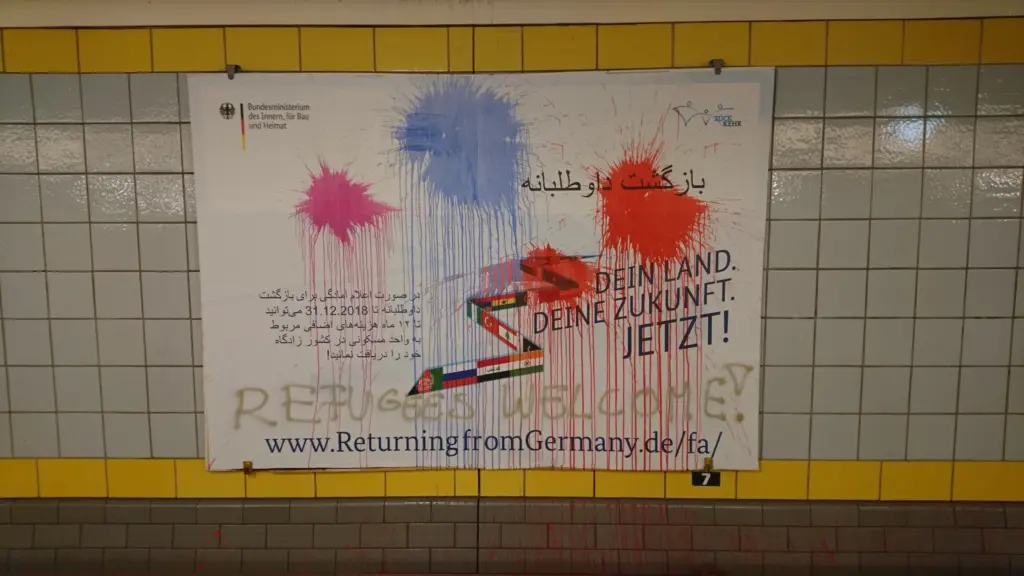
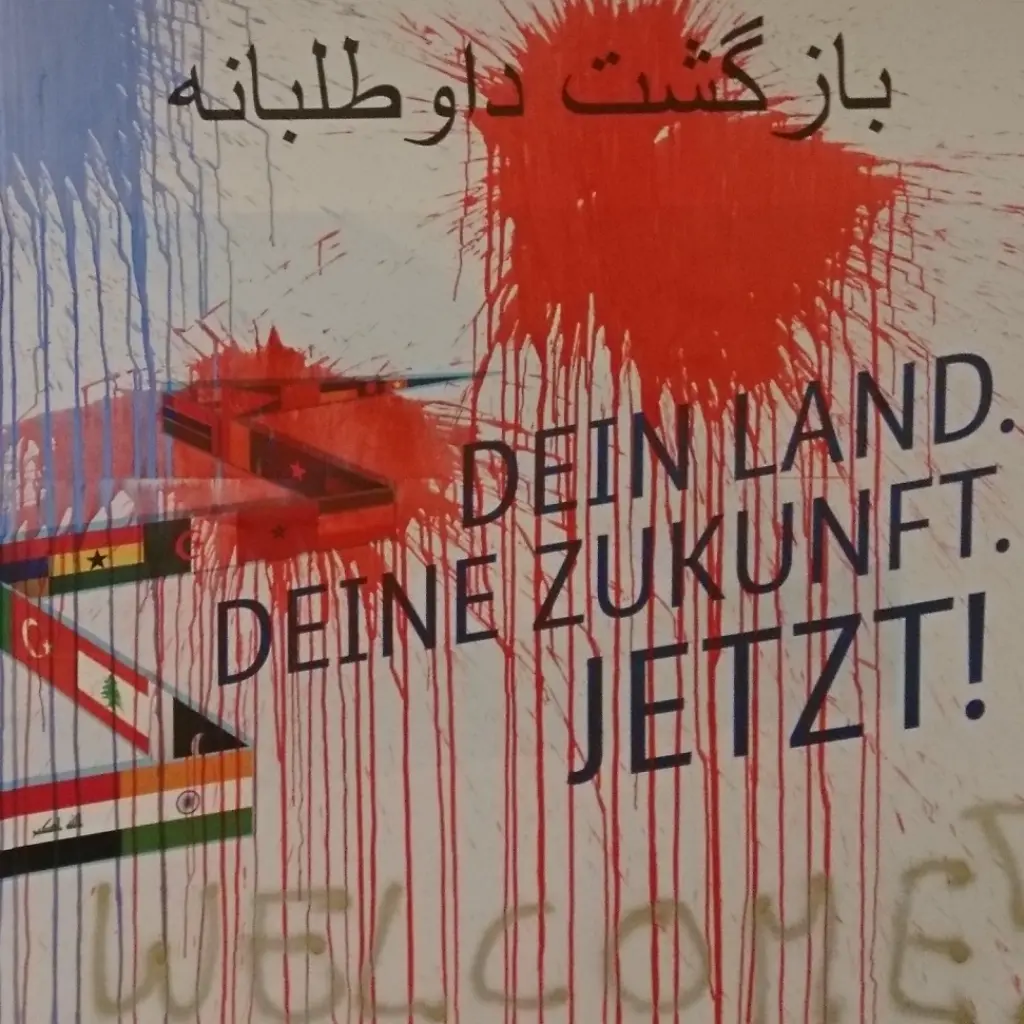
Poster at metro station Hermannplatz in Berlin. Photo: Inga Dreyer
Imagine walking through the streets when suddenly a poster catches your attention and makes you stop. What it says causes you to feel the urge to leave. A strange feeling of discomfort starts to spread through your entire body: You’re unsure whether to feel uncomfortable, unwelcome or rejected?
Since the middle of November, this is exactly what has come to the minds of many people living in Germany. It is since then that the German Federal Ministry of the Interior has been promoting a campaign providing migrants and refugees with financial support if they decide to voluntarily return to their “home country”.
Return in “winter sale”
The campaign called “Your country. Your future. Now!” is in addition to the voluntary return program already started by the Federal Ministry last year. The campaign addresses migrants with a particular status, who are obliged to leave the country (German: “ausreisepflichtig”). Due to a decline in the numbers of people making use of the offer in 2018, the ministry decided to establish a bonus payment between 1000€ for a single person and up to 3000€ for a whole family.
While the ministry defends its campaign as a legitimate way of raising more awareness of the program, other associations see it as obtrusive and pushy, with the Green Party even comparing the advert to an offensive “winter sale”.
“The idea of the campaign is disturbing, because people who have migrated to Germany did not do it for nothing – they had a reason – they ran away from war”, explains Nour Alabras, a 25-year-old Syrian photographer who studied graphic design in Syria and fled to Germany in October 2015. Even though Nour is not directly addressed by the campaign due to her status, she feels mixed emotions. The campaign has caused her to wonder where she actually belongs: “I feel like I’m stuck in the middle”.
“I wanted to make a big change”
Before the Syrian revolution started in 2011, Nour regarded her religious beliefs as playing a significant role in defining her identity. She described herself as a “very devout Muslim” who wore a hijab and prayed faithfully at the mosque.
Everything began to change when the war started. Even though Nour’s hometown Alnabek felt the consequences of the war much later, she felt the urge to protest against the Assad regime very early: “Protest seemed to me like the most righteous thing to do. I also felt that I was changing during the war. My thoughts started to change drastically, I read many books about revolutions in other countries: I wanted to make a big change!” However, due to low levels of participation in protests in her hometown, she started to demonstrate in other cities in the region.
As well as her own active engagement, Nour thought it necessary to mobilize more people to raise their voices against the regime and convince them of the importance of protesting.
A safe place to express your identity
If you would meet Nour these days – who currently lives in Berlin – you wouldn’t get the impression she is a very religious person. She’s neither wearing a hijab nor does she go to the mosque.
When discussing this with Nour, she attributes the changes in her religious identity to the different social surroundings after coming to Germany. Nour perceived Germany as a safe place to live out her beliefs and be accepted as an atheist. At the same time, the fear of what her family in Syria would think didn’t leave her: “Even after I was already in Germany I found it difficult to confront [them] with the changes I had undergone.”
For Nour the result of this freedom to express her newly acquired identity in Germany has opened up the question more and more of where she actually belongs. Nour appreciates the freedom she has in Germany to express herself and definitely considers herself “integrated”. But she also has to face aspects of life in Germany that make it difficult for her to fully regard it as “her country”: “I don’t think I will ever get along with the cold here, but I hope that one day I will acclimatise to the system and speak the language fluently”.
When it comes to choosing whether she belongs in Germany or Syria, Nour feels conflicted. She is aware of her Syrian background but feels rejected by the Syrian community on account of her not being religious and describes her first contact with other Syrians in Germany as extremely tense. She and her husband had to deal with very aggressive reactions: “They moved us to collective accommodation with three other Syrian couples. We stayed there for two months but my husband and I had a lot of problems because we weren’t Muslims (…) and the other couples were. They weren’t even ‘conservative’ but still they had big problems accepting us being different.”
When Nour talks about the campaign of the Federal Ministry of the Interior one can perceive her indecisiveness about whether she would call Syria or Germany her “home”. She describes mixed emotions concerning the campaign: “Obviously I miss my hometown, but no way would I go back to Syria as long as Bashar Al-Assad is there – because there will be no benefit in that. [If I did that] I would go back to zero. All this suffering would be for nothing”.
Today Nour is part of a community of Syrian people who have experienced similar identity changes in Germany. In her case this change is marked by her religious conversion and standing by her own beliefs. At the end of the day the changes one experiences after living in another environment are irreversible: “If I would go back to Syria now, I would have to lie about my real identity”.